Affiliate Marketing for Beginners: How It Works
Affiliate marketing for beginners sounds like free money: share a link, get paid. The real version is simpler than the hype and slower than the ads — you recommend a product you understand, someone buys through your link, and the company pays you a share of the sale. No product of your own, no customer service, no shipping. But the income only shows up after you build trust and traffic, and that part takes weeks or months.
What affiliate marketing actually is
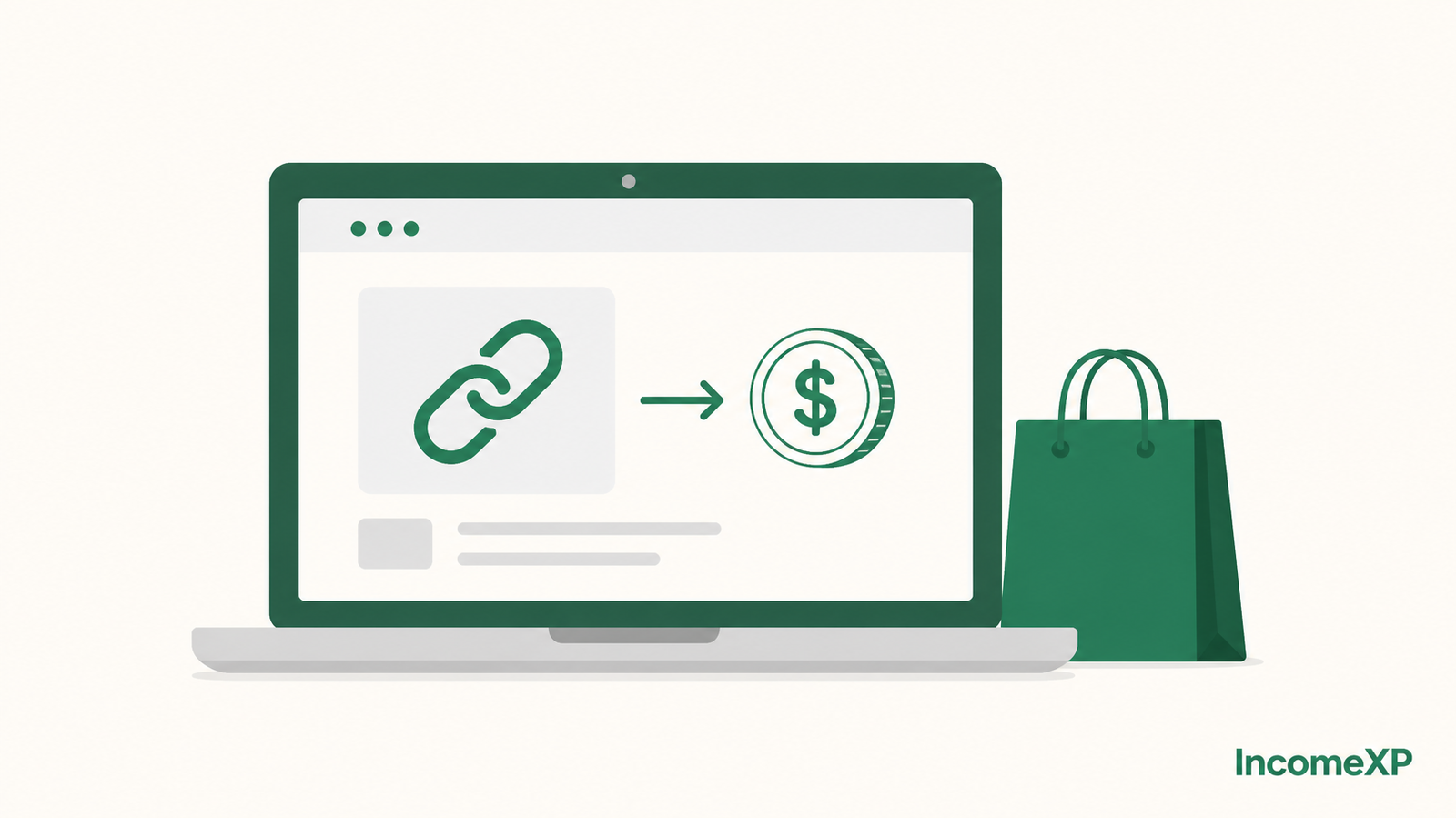
Affiliate marketing is a referral deal. A company gives you a special link that tracks clicks from your content to their site. When someone clicks your link and buys within a set window — often 30 days, sometimes 7, sometimes 90 — the company pays you a commission, usually a percentage of the sale or a flat amount.
There are four players in every affiliate sale:
- The merchant — the company selling the product, for example a software company or a retailer.
- The affiliate (you) — the person recommending the product through content.
- The customer — the person who clicks and buys.
- The network or platform — the middleman that tracks clicks and pays out, such as Impact, PartnerStack, or an in-house program.
You do not handle the product, the payment, or the refund. Your job is the recommendation and the content around it.
How you actually earn
A commission is only paid on a completed, tracked sale. The exact amount depends on the program:
- Percentage of sale. Common for software and subscriptions — for example, 20 to 40 percent of the first payment, or a smaller share that repeats each month while the customer stays subscribed.
- Flat amount per sale. Common for services — for example, a fixed dollar amount every time someone signs up.
- Per lead. Some programs pay when a visitor signs up for a free trial or fills in a form, even without a purchase.
A cookie is what connects the click to the sale. When someone clicks your link, the merchant’s system drops a cookie in their browser. If they buy within the cookie window, the sale counts as yours. If they buy after the window closes, or click someone else’s link after yours, you get nothing.
What it costs to start
Affiliate marketing has one of the lowest start-up costs of any online income idea, but it is not free:
- A place to publish. A simple website or blog costs roughly $3 to $10 a month for hosting, or nothing if you start on a free platform. A website you own is better long term — you control it, and it builds search traffic.
- An affiliate program account. Joining programs is usually free. Some networks ask for a website before they approve you.
- Your time. Writing a genuinely useful review or guide takes a few hours, and a site needs dozens of posts before search engines send steady traffic.
A realistic timeline
Forget the screenshots of overnight earnings. A normal beginner timeline looks like this:
- Weeks 1–2: Pick a topic you know something about, set up a site, and join one or two programs that fit it.
- Weeks 3–8: Publish useful content regularly. Expect almost no clicks at first.
- Months 3–6: Search engines start sending visitors. A few clicks turn into a first sale. Many beginners earn their first $10 to $100 in this window.
- Months 6–12: If you keep publishing, traffic compounds. Some months pay more, some pay nothing.
If a program promises fast money with no audience and no content, that is a sales pitch, not a plan.
How to pick what to promote
Your first product choice matters more than your first post. Use these checks:
- It fits your topic. A blog about freelance tools should recommend freelance tools, not random gadgets.
- People already search for it. If nobody is looking for the product, your content has no audience.
- The company is real and reputable. Check that the product has genuine reviews, a working website, and a clear refund policy. Your readers will blame you if the product is bad.
- The terms are clear. Know the commission, the cookie window, and the payout minimum before you write a word — some programs only pay out after you reach $50 or $100.
The disclosure rule — do not skip this
In the US, the FTC requires you to disclose affiliate relationships clearly. That means a short, plain note near your link or at the top of the post, such as: “This post contains affiliate links. If you buy through them, I may earn a commission at no extra cost to you.” This is not optional — and it actually helps, because readers trust a clear disclosure more than a hidden one.
Mistakes beginners make
- Promoting everything. A page full of links reads like an ad, and readers leave.
- Copying the sales page. Your job is to add your own experience, comparison, or honest drawbacks — that is what readers cannot get from the product page.
- Hiding the disclosure. Or burying it at the very bottom in tiny text.
- Quitting at week three. Traffic takes time. Three posts and no sales is normal, not proof the model is broken.
A simple first-month plan
- Pick one topic you can write about for six months without getting bored.
- Set up a simple site and publish four to six genuinely helpful posts that do not sell anything.
- Join one program that fits your topic and add links only where they genuinely help the reader.
- Learn the basics of search. Use clear titles, answer the reader’s question early, and write for humans first.
- Track what happens. Which posts get clicks? Which links get used? Do more of what works.
Affiliate marketing is a slow, honest way to earn from content you were going to make anyway. Start small, recommend things you believe in, disclose clearly, and give it time to work.
FAQ
Do I need a website to start affiliate marketing?
No, but it helps a lot. You can share links on social media or video platforms, but a website you own builds search traffic over time and keeps working while you sleep. Most programs also ask for a website when you apply.
How much can a beginner realistically earn?
Most beginners earn little or nothing in the first two or three months. A realistic first-year goal is a few hundred dollars total, growing from there if you keep publishing. Anyone promising hundreds a week from day one is selling a course, not describing the work.
Do I need to buy the product before I promote it?
Usually no. Many programs let you join and promote without buying. But using the product — even through a free trial — makes your recommendation more honest and more useful to readers.
IncomeXP publishes practical, hype-free guides to earning more — no promises, just information you can use.