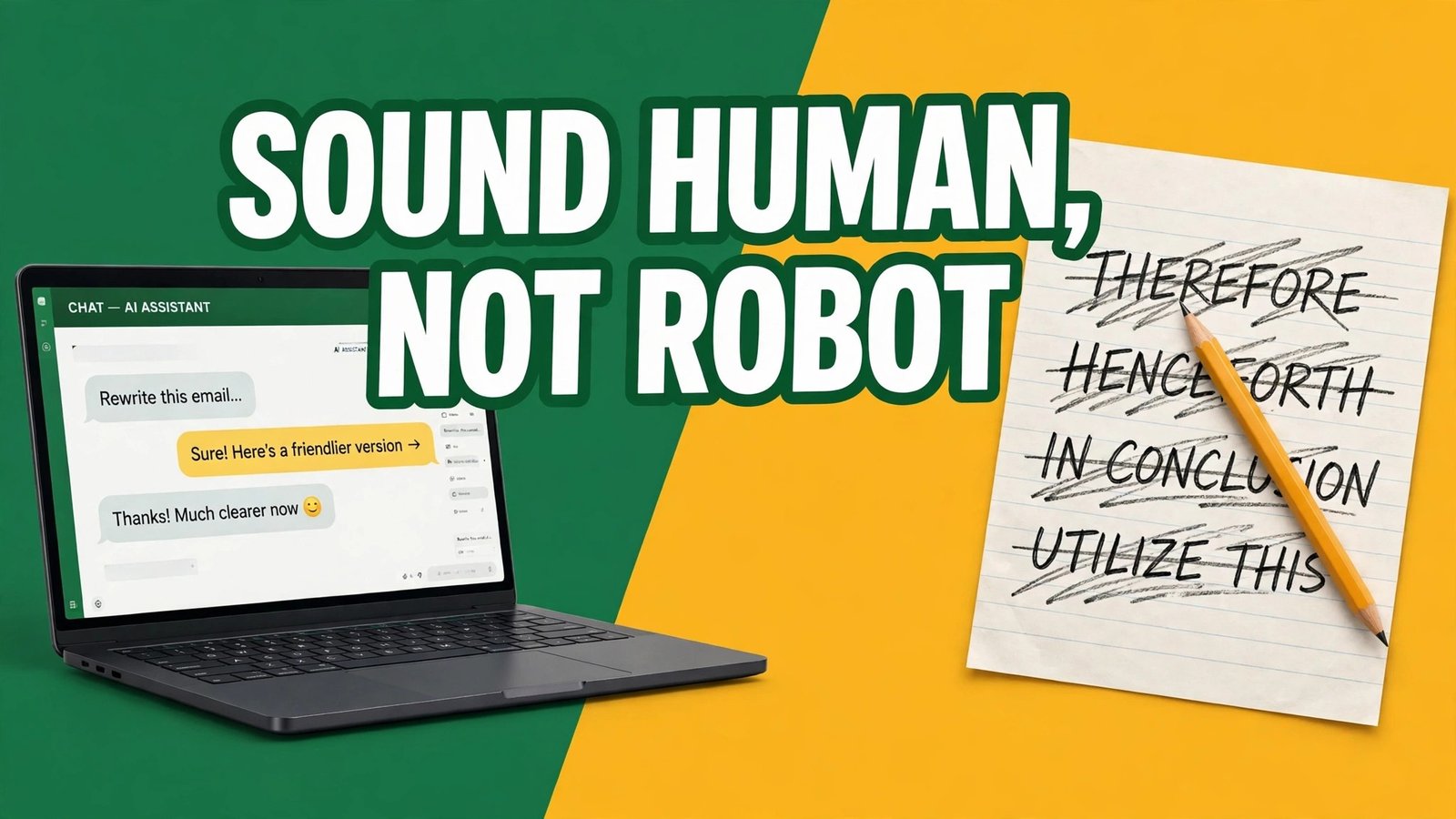
Learning how to use AI tools without sounding like a robot comes down to one habit: never publish the first draft AI gives you. AI writes clean, correct sentences — and that is exactly the problem. Its default voice is polite, vague, and the same as everyone else’s. A short edit pass turns that generic draft into something that sounds like you.
Why AI Writing Sounds Robotic
Read any untouched AI draft and the same fingerprints show up: sentences all roughly the same length, paragraphs all starting the same way, and the same phrases again and again — “in today’s fast-paced world,” “it’s important to note that,” “delve into,” “furthermore.” Real people rarely talk like that.
Three things cause the flat tone. First, AI averages everything it has read, so it writes in the middle of the road — never too casual, never too direct. Second, it avoids specifics, because specifics can be wrong, so it fills space with general claims. Third, it hedges: “may,” “can,” “could,” “potentially.” A sentence that hedges three times says almost nothing.
Readers notice, even if they cannot name it. A client email that sounds like a brochure gets skimmed; a social post that sounds like everyone else’s gets scrolled past. The fix is not to stop using AI — it is to treat the AI draft as raw material and finish it yourself.
How to Use AI Tools Without Sounding Like a Robot: The 10-Minute Edit
Set a timer and run every AI draft through these five steps before it goes anywhere:
1. Read it out loud. If a sentence feels awkward in your mouth, it will feel awkward on screen. Rewrite it the way you would say it to a friend — this one step catches half the robot voice.
2. Cut the filler phrases. Delete “in today’s world,” “it’s worth noting,” “delve,” and “furthermore.” If removing a phrase changes nothing, it did not need to be there.
3. Add one specific detail per section. Replace a vague claim with a real number, example, or story: “Many freelancers struggle with pricing” becomes “I charged $25 an hour for two years before I raised it.” AI cannot invent your experience, and specifics are the fastest way to sound human.
4. Add one opinion. AI avoids taking a side; you should not. “Paid tools are better” is boring. “I tried the paid plan for a month and cancelled it — the free version does everything I need” is a person talking.
5. Vary the sentence length. AI loves medium sentences. Break the rhythm: a short sentence. Then a longer one that explains the idea properly. Short sentences create emphasis. Long ones carry detail. Mixing them is what natural writing sounds like.
Ten minutes of this turns a generic draft into something only you could have written.
Write Better Prompts So the First Draft Is Closer
A good edit fixes a bad draft, but a good prompt means less editing. The way you ask shapes the voice you get back:
- Give it your voice to copy. Paste two or three sentences you actually wrote and say, “Write in this style — short sentences, plain words, direct tone.” AI imitates examples far better than descriptions like “make it casual.”
- Name the audience. “Explain this to a beginner who has never freelanced” produces simpler, warmer writing than “write about freelancing.”
- Ban the stock phrases. Add “Do not use: delve, furthermore, in today’s fast-paced world” to your prompt. It works surprisingly well.
- Ask for short, then expand. Long first drafts wander; short ones stay focused.
- Ask for options, not one answer. “Give me three versions of this opening line” lets you pick the one that sounds most like you.
Keep a note of the prompts that work and reuse them — a good prompt is a tool you build once and use for months.
Keep the Parts Only You Can Write
AI is best at the parts nobody sees: the outline, the first draft, the list of ideas, the summary of a long article. It is worst at the parts only you can do — and those are the parts readers remember.
Your stories, numbers, opinions, mistakes, and the specific client example from last Tuesday all belong to you. AI cannot write any of those, and if you let it try, it will invent them — which is worse than leaving them out.
A practical split: let AI draft the structure and the plain explanations, then write the opening story, the examples, and the conclusion yourself. Those three spots carry most of the personality in any piece.
Where Robotic Text Hurts Most (and Where It Does Not Matter)
Not every piece of writing needs your voice. Internal notes, outlines, summaries for yourself, and the first messy draft of anything — let AI be as robotic as it likes there. Nobody else will read them.
It matters most where trust is on the line: client emails, proposals, your About page, social posts, and anything with your name on it. A proposal that reads like a template makes the client wonder if the work will be templated too, and an outreach email that sounds like a machine gets deleted like spam.
Before you send anything important, ask one question: would the reader believe a real person wrote this? If the answer is no, run the 10-minute edit.
A Quick Checklist Before You Hit Send
- I read it out loud and it sounds like me.
- The filler phrases are gone.
- There is at least one specific example or number.
- There is at least one opinion, not just facts.
- No sentence claims experience or results I do not have.
- The opening line could only have come from me.
If a draft passes all six, it is ready. If it fails two or more, give it another five minutes — or rewrite the opening yourself.
FAQ
Can readers actually tell when text is AI-written?
Often, yes — even without a detector. The flat rhythm, the stock phrases, and the lack of specifics give it away. Clients may not say “this is AI,” but they will feel it is generic.
Is it cheating to use AI for writing?
No, as long as you check the result and make it your own. Using AI to draft, then editing it into your voice, is like using spellcheck — a tool, not a replacement for thinking. Passing off untouched AI text as your own work is where it becomes a problem.
Do I need a paid AI tool to sound more human?
No. The human sound comes from your edit, not from the tool. Free AI tools write drafts that are just as good a starting point — the difference is what you do with them afterwards.
What is the single biggest giveaway of AI writing?
Vague, hedged sentences with no specifics and no opinion. One real example or one clear opinion in the first paragraph removes most of the robot feel.
IncomeXP publishes practical, hype-free guides to earning more — no promises, just information you can use.