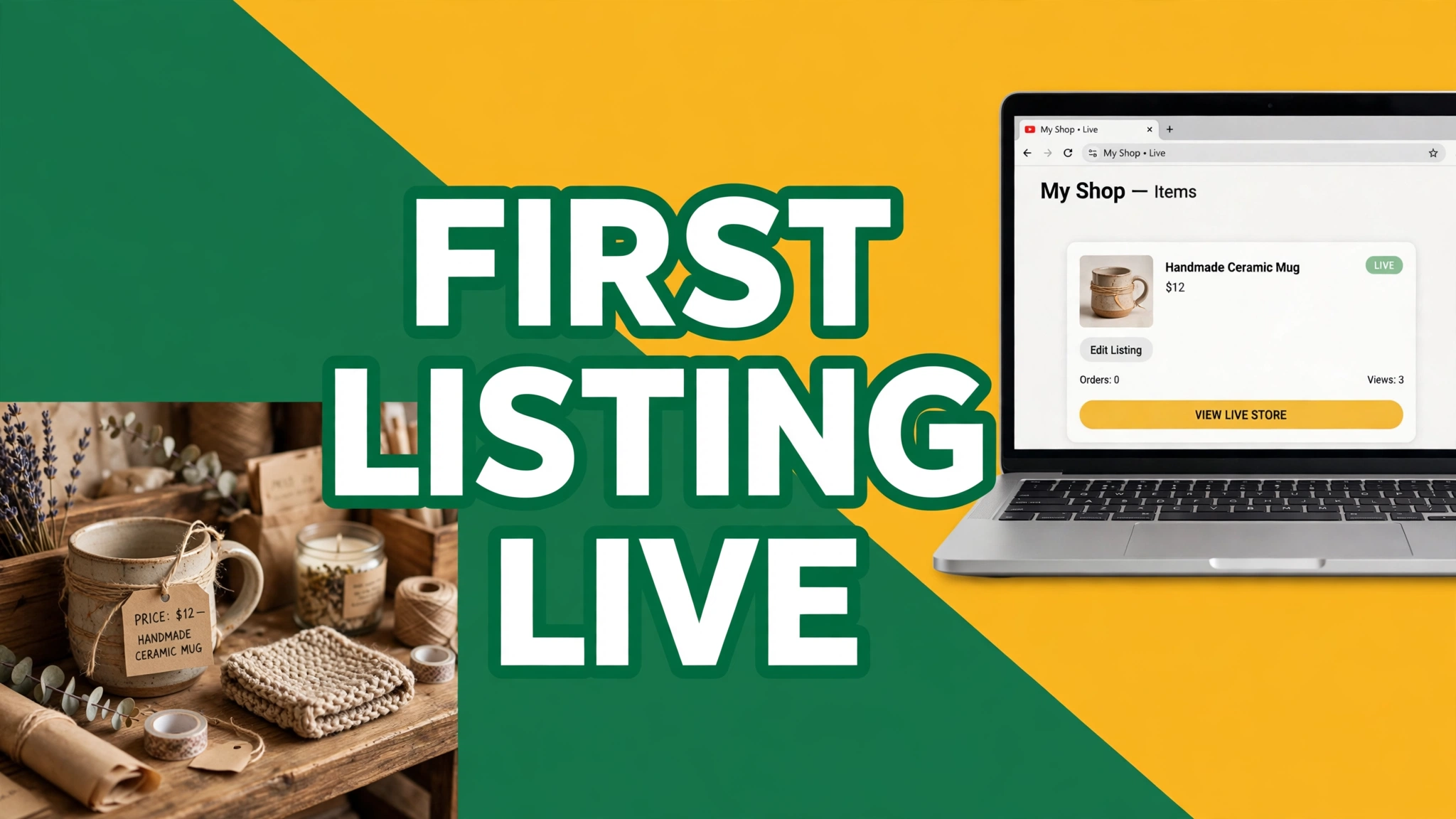
To sell on Etsy for beginners, the fastest path is one simple listing: a single product, clear photos, a price that covers Etsy’s fees, and a title written the way a buyer would search. You do not need a full shop, a brand, or ten products to start. One honest listing teaches you more about selling on Etsy than a week of research, and you can build the rest of the shop around whatever that first listing tells you.
What Selling on Etsy Actually Costs
Etsy is cheap to start, but it is not free — and the fees are the first thing to understand, because they decide your price. Here are the main ones, in US dollars:
- Listing fee: $0.20 per listing. Each listing lasts four months or until the item sells. Relisting costs another $0.20.
- Transaction fee: 6.5% of the total sale price, including what the buyer pays for shipping.
- Payment processing fee: 3% + $0.25 on each order in the US.
- Offsite Ads fee: 12–15%, but only if Etsy runs an ad that leads to your sale — and only for shops that earn over $10,000 a year is it mandatory; smaller shops can turn it off.
Do the maths on a $20 item before you list it: $0.20 + $1.30 transaction fee + $0.85 processing = about $2.35 in fees, leaving roughly $17.65 before your materials and time. That is why a $3 item rarely makes sense on Etsy — the fees eat it. Aim for a first listing priced at $10 or more, and higher if your materials cost anything at all.
There is no monthly shop fee. You pay as you list and sell, which makes Etsy one of the lowest-risk places to test whether anyone wants what you make.
Pick Your First Product (Keep It Simple)
Your first listing should be something you can make, photograph, and describe in an afternoon. Two routes work best for beginners:
Digital downloads. Templates, printables, planners, and simple designs. You make the file once, and every sale is the same file sent automatically — no packing, no postage, no stock. A one-page planner, a set of social media templates, or a simple budget tracker are all realistic first listings. Digital products also dodge the trickiest part of Etsy for beginners: shipping.
One simple physical item. A handmade candle, a printed mug, a sewn pouch, a piece of simple jewellery. Pick the one item you already make well, not the ten you might make one day. One product, done properly, beats a shop full of half-finished ideas.
Avoid these for your first listing: anything that needs sizing (clothing fits are a returns headache), anything fragile or heavy to post, and anything you cannot remake quickly if it sells. You want your first sale to feel good, not like a logistics problem.
Set Up Your Shop in an Afternoon
Opening a shop takes about an hour, and most of it is small decisions you can change later:
- Create your account and choose a shop name. Pick something short and easy to spell. It should hint at what you sell, not just sound clever — buyers search for products, not brand names.
- Add a shop icon and a banner. A clean photo of your product works fine as an icon. The banner can be a simple photo of your workspace or your best item — a phone photo in good light is enough.
- Write a short “About” section. Two or three sentences: what you make, why you make it, and who it is for. Buyers on Etsy like knowing a real person made the thing.
- Set your shop policies. Etsy gives you standard templates for shipping times, returns, and exchanges. For a first listing, keep it simple: state your processing time honestly (for example, “ships in 3–5 business days”) and say whether you accept returns.
- Connect a payment method and a bank account. Etsy pays out on a schedule you choose — daily, weekly, or monthly — minus the fees above. Your first payout can take a few days while the account is verified.
Do not spend a week perfecting the shop before listing anything. A shop with one good listing beats a beautiful empty shop every time.
Write a Listing That Gets Found
Etsy is a search engine as much as a shop. Buyers type what they want, and your listing shows up — or does not — based on the words you use. Write for the search bar, not for poetry.
- Title: use all 140 characters. Put the most important words first, the way a buyer would type them: “Printable Budget Planner PDF, Monthly Budget Tracker, Instant Download” beats “My Lovely Planner”. Repeat your main phrase in the first few words.
- Tags: you get 13. Use all of them, and make them phrases buyers actually type — “budget planner printable”, “monthly budget pdf”, “finance planner download” — not single words like “planner” on its own.
- Description: the first two sentences matter most, because that is what shows in search results. Say what it is, who it is for, and what they get — then add the details: size, format, how it is delivered, and what is included.
- Materials and attributes: fill them in. Etsy uses these as search filters, and a listing with them filled in shows up in more searches than one left blank.
One warning: do not copy another seller’s title or description word for word. Apart from being poor practice, Etsy buyers notice, and your listing will read like everyone else’s. Write it in your own words, describing your own product.
Take Photos That Sell (With Your Phone)
You do not need a camera or a studio. A phone, daylight, and a plain background will do — but photos are the single biggest reason a buyer clicks or scrolls past, so give them ten honest minutes:
- Use natural light near a window. Morning light is softest. Never use the phone flash — it flattens everything and makes colours look wrong.
- Use a plain background. A white sheet, a clean wooden table, a plain wall. The product should be the only thing competing for attention.
- Show the item in use. A planner open on a desk with a pen beside it sells better than a planner on its own. A mug held in a hand shows its size better than a ruler does.
- Include a scale shot. One photo next to a common object — a coin, a hand, a laptop — so buyers know how big it is.
- Upload all ten photo slots. More photos mean more chances to show detail, and listings with more photos tend to rank better. Different angles, a close-up of the detail, and the packaging if it looks good.
For a digital download, show the product as if it were real: a mockup of the planner on a tablet screen, the template printed and lying on a desk. Buyers need to picture using it.
Price Your First Listing (Without Guessing)
A simple formula keeps you out of trouble: materials + fees + your time = your price, rounded up to a clean number.
Say a printable costs you nothing in materials and took three hours to design. You are not going to earn those three hours back on the first sale — and that is normal. Price it at $8–$12, a range buyers accept for a useful printable, and think of the first sales as paying for what you learn, not for your time.
For a physical item, work it out properly. A candle that costs $4 in wax, jar, and wick, plus $2.35 in fees on a $20 price, plus $6 postage if you offer free shipping, leaves about $7.65 for your time. If that feels too low, the price is too low — raise it, or make the item cheaper to produce. Never price below your costs to “get started”. Cheap prices attract the hardest customers and teach you nothing about what your work is worth.
What to Expect in Your First Month
Here is the honest version, so the first month does not feel like failure:
- Sales: zero to five is normal. Etsy is a search marketplace — new listings take time to appear in results, and a shop with one listing and no reviews is a slow starter.
- Views: a handful a day, mostly from your own shares. Share the listing link where you already talk to people — a social post, a message to a friend, a community you are part of.
- Reviews: your first review matters more than your tenth sale. A short thank-you message after delivery, asking buyers to leave a review if they liked it, is worth doing — but never offer anything in exchange for a review, which breaks Etsy’s rules.
- Time: about an afternoon to set up, then 30 minutes a week to check messages, update the listing, and add a photo or two.
The first listing is the hard part. The second one is faster, the fifth one is routine, and by then you will know — from real views and real sales — what buyers actually want from your shop.
FAQ
Do I need a business licence to sell on Etsy?
In most places, no — you can start as an individual. Rules vary by country and by what you sell, so check your local requirements before you scale up, and keep records of your income from day one.
How much money do I need to start selling on Etsy?
As little as $0.20 for one listing, plus whatever your product costs to make. A digital download needs almost nothing beyond your time; a physical item needs materials and packaging.
How long does it take to get your first sale on Etsy?
Anywhere from a few days to a few months. It depends on how many people search for what you sell and how well your listing matches their words. Sharing your listing yourself speeds it up a lot.
Can I sell digital products on Etsy?
Yes — digital downloads are one of the most popular things on Etsy, and they are the easiest first listing because there is no shipping, no stock, and no packaging. The buyer downloads the file automatically after paying.
IncomeXP publishes practical, hype-free guides to earning more — no promises, just information you can use.