How to Track Side Hustle Income for Tax Season
This post covers record-keeping basics only. It is not tax advice. Tax rules vary by country and situation, and they change — when in doubt, talk to a qualified tax professional.
When you earn money from a side hustle, tax season stops being something that happens to you and becomes something you prepare for. The good news: tracking side hustle income is not complicated. A simple system you actually use beats a fancy accounting setup you abandon by February. Here is how to build that system from your very first paid job.
Why tracking beats guessing
Three reasons to keep records from day one. First, you will owe taxes on this income in most places, and guessing at your numbers months later is how people underpay, overpay, or miss deductions they earned. Second, tracking tells you whether the hustle is actually worth your time — many beginners discover their “great” gig pays less than minimum wage once they count all the hours. Third, clean records protect you: if a client disputes what they paid or a payment app reports different numbers than you remember, your notes settle it.
The simplest system that actually works
You need one spreadsheet with two tabs: Income and Expenses. A free spreadsheet app like Google Sheets is more than enough for a one-person side hustle.
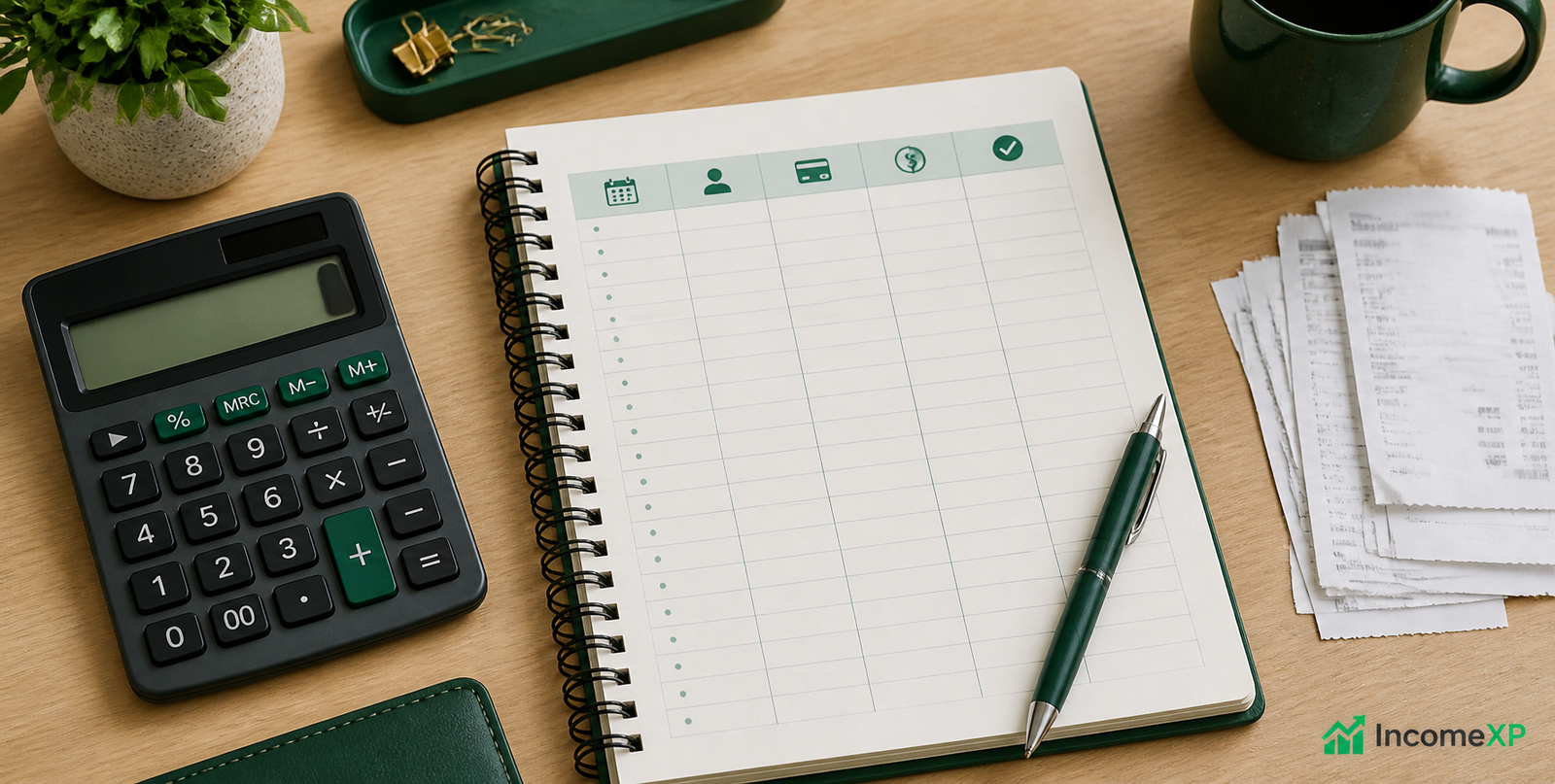
Your Income tab needs these columns: date paid, client or platform name, what the work was, amount received, how you were paid (bank transfer, cash, payment app), and invoice or receipt number if you have one. One row per payment. That’s it.
Your Expenses tab needs these columns: date, what you bought, which job or hustle it was for, amount, and how you paid. Record expenses the same day you spend the money — a photo of the receipt on your phone takes ten seconds and saves you from the shoebox problem later.
Update both tabs weekly, in one ten-minute sitting. Pick a day — Sunday evening works for most people — and make it a habit like brushing your teeth.
What to write down for every payment
Side hustlers usually remember the big payments and forget the small ones, but small ones add up. Record every payment, including:
- The full amount, before any platform fees were taken out (note the fee separately in expenses if you want to track it).
- Cash payments. Cash is the easiest income to forget. Write it down the moment you receive it — a notes app on your phone works when you’re away from your spreadsheet.
- Tips and bonuses. These count as income too, even when they feel like gifts.
- Barter. If someone pays you with goods or services instead of money, note what you received and a reasonable cash value for it.
- Payments still owed. Add a simple status column — paid, invoiced, or overdue — so you can see at a glance who still needs to pay you.
A useful rule: if money or value came to you because of your side hustle, it goes in the Income tab. When in doubt, record it. Extra records never hurt; missing records often do.
Separate your side-hustle money
Open a separate bank account — or at minimum a separate savings pocket — for your side hustle. It does not need to be a special business account at first; a second personal checking account works fine in most places.
Why this matters: when every side-hustle dollar lands in one account and every business expense leaves from the same account, your tracking takes care of itself. The account statement becomes a backup of your spreadsheet. When everything is mixed into your personal account, you will spend hours untangling which coffee was a business meeting and which was just coffee.
One more habit: pay yourself from that account on a schedule, like the first of the month. Move a fixed amount (or everything above a floor you keep for expenses) to your personal account. This turns lumpy side-hustle income into something that feels like a paycheck.
Save a slice of every payment for taxes
This is the habit that saves beginners from the worst tax-season surprise: owing money they already spent. The rule is simple — every time side-hustle money arrives, immediately move a fixed percentage of it into a separate savings account and do not touch it.
How much? That depends on your country, your total income, and your situation, so this is exactly where a tax professional or your country’s tax authority guidance earns its keep. As a starting point, many self-employed beginners set aside roughly a fifth to a third of each payment and adjust once they learn their actual situation. The exact number matters less than the habit: money set aside the day you’re paid is money that exists in April. Money you “plan to save later” usually doesn’t.
Also note: in some countries, the self-employed must pay estimated taxes quarterly rather than once a year. Check your country’s rules early — this is one of the most common beginner surprises, and it’s much better to discover it in your first month than your twelfth.
Track the miles and the receipts, too
Two categories of expenses beginners consistently under-record:
- Mileage. If you drive for your side hustle — deliveries, client visits, supply runs — note the date, the purpose, and the miles for every trip. A running note on your phone, updated when you park, is enough. At tax time, this log is worth real money.
- Receipts. Supplies, tools, software subscriptions, and anything you buy specifically for the hustle. Photograph every receipt the day you get it and keep the photos in one folder. Physical receipts fade; phone photos don’t.
Keep both for several years after you file — your country’s tax authority can ask questions about past years, and your records are your answers.
Mistakes that cost side hustlers money
- Waiting until tax season to start. Reconstructing a year of income from memory and old bank statements is miserable and inaccurate. Start the spreadsheet with your first dollar.
- Ignoring the small stuff. Ten unrecorded $20 payments are $200 of income you can’t explain. Record everything.
- Spending the tax slice. The separate savings account only works if you treat it as locked. Move the money the day you’re paid, before you have time to mentally spend it.
- Assuming the platform handles it. A payment app or marketplace may send you a tax form — or it may not, depending on thresholds that change. Your own records are the source of truth either way.
- Mixing personal and hustle spending. Every mixed transaction is a future headache. Keep the accounts separate from the start.
None of this requires accounting knowledge. It requires a spreadsheet, a separate account, ten minutes a week, and the discipline to move money aside the day it arrives. Start that system with your next payment, and tax season becomes a formality instead of a panic.
IncomeXP publishes practical, hype-free guides to earning more — no promises, just information you can use.